
Amazon: The Robotics Powerhouse

Instead of going over the market today, I wanted to discuss Amazon after their earnings report.
Subscribers know I initiated a position in Amazon last Thursday 10/23 around $220 and mentioned I planned on making this a core swing position for a trade into 2026+.
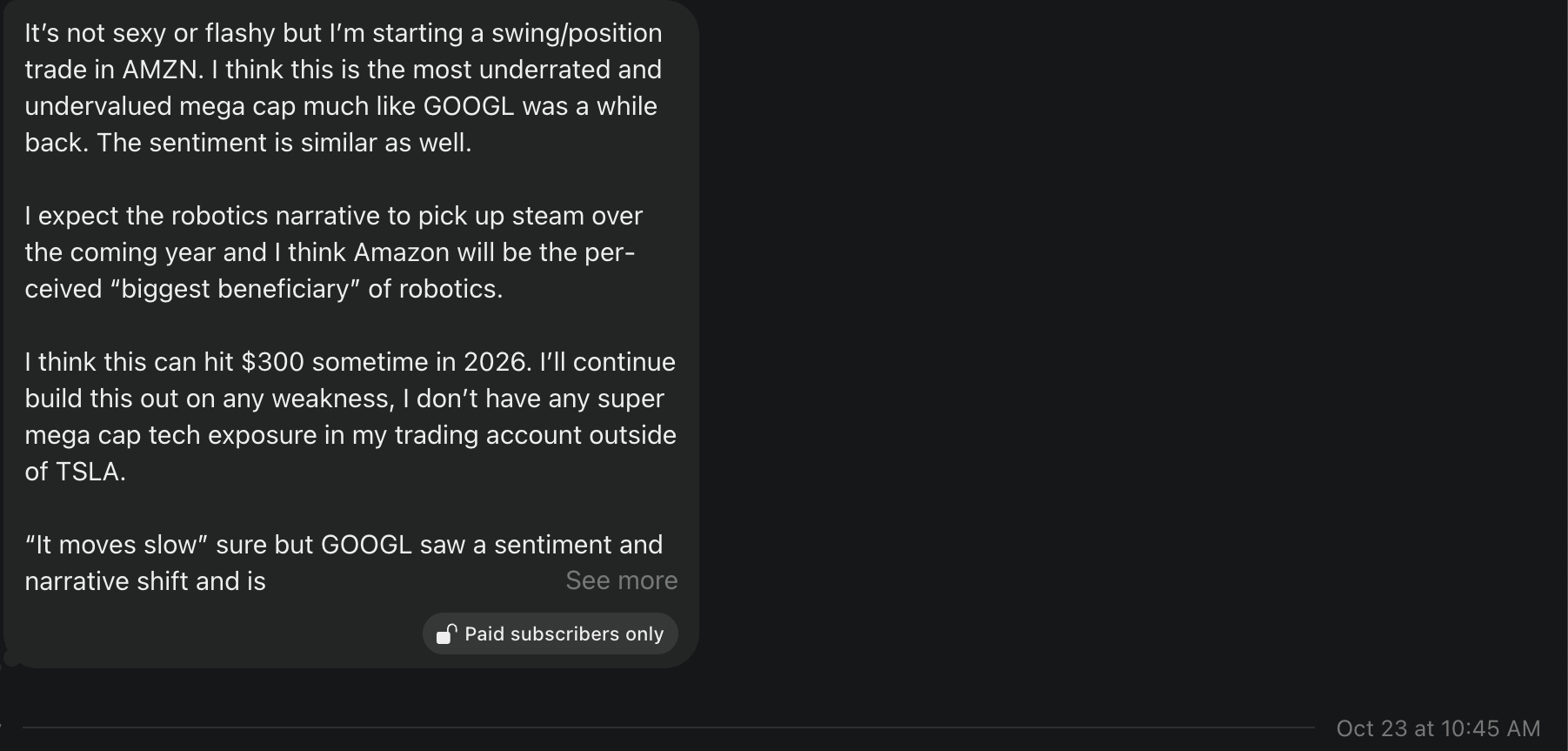
Why? Robotics.
The sentiment around Amazon reminded me a lot of Google. I haven’t seen sentiment this poor on a mega cap since Google a few months ago, or even Apple around that same time period. Amazon has been viewed as the “ugly sibling” of the Magnificent 7 and has been the biggest laggard over the last five years. Let’s look at the returns of the group over that time:
NVDA +1,518%
GOOGL +248%
TSLA +240%
MSFT +160%
META +153%
AAPL +149%
QQQ +147%
AMZN +47% (before tonights move)
Amazon sticks out like a sore thumb. +47% is abysmal performance relative to all of the other names listed, it’s even underperforming the Nasdaq. That told me there is potential of a major catchup trade here.
Amazon has built the largest commercial robotics operation on the planet and keeps layering in new form factors. Mobile robots, vision guided arms, storage systems, and now even early humanoids. The current fleet spans Proteus AMRs (autonomous mobile robots) that move carts, AI arms like Sparrow/Robin/Cardinal for item and package handling, and the Sequoia storage system that reorganizes inventory for faster pick up by employees. Amazon says it now operates over a million robots across its network! We’re just in 2025… imagine years down the line when advanced robotics system exist, and humanoids are functional and useful. An Amazon humanoid will be able to package and process shipments more efficiently than a human can. It sounds dystopian but reality is, most of the workers these robots will replace are seasonal and often don’t stick around very long.
The near term economics are about unit cost and speed. Morgan Stanley estimates that the long run savings potential is upwards of $10B annually by 2030 if 30–40% of U.S. volume runs through highly automation! What does that mean? Higher packaged items per labor hour, faster cycle times, and a structurally lower cost to serve that will show up in margins.
The medium term product roadmap even broadens where robots can work and shows just how much Amazon is investing here. Strategically, robotics even expands Amazon’s moat: faster delivery promises without exponential headcount growth, a more efficient workplace narrative, and fulfillment economics that rivals struggle to match without multi year CapEx and software/hardware talent hiring. It also hedges wage and availability risk while supporting the shift to same day footprints. The competitive backdrop from Symbotic, Ocado solutions, Exotec, and other players is weak. Amazon has so much more capital to deploy and invest than any other competitor.
Below, I’m going to go over the ten robots Amazon is using in warehouses today. Not prototypes or “coming soon” robots, these are functioning right now.
1. Sequoia – AI powered system that organizes and stores inventory up to 75% faster. It uses mobile robots to move products directly to workers or storage containers, improving speed and ergonomics in fulfillment centers.
2. Hercules – A drive unit that carries pods of items to employees for order picking. It navigates using floor markers and cameras, safely moving around people and other robots.
3. Titan – Similar to Hercules but much stronger. It moves larger and heavier items like appliances and pallets, doubling Hercules’s lifting capacity.
4. Vulcan – A robot arm with a sense of touch that can pick and stow items at high and low levels. It uses force feedback and computer vision to handle objects carefully and works alongside employees for safer, more efficient picking.
5. Blue Jay – A ceiling mounted system designed for Amazon’s same day delivery sites. It coordinates multiple robotic arms to pick, sort, and consolidate packages rapidly in one workflow.
6. Sparrow – A robotic arm that uses AI and computer vision to identify and move individual items from bins into totes for packaging. It automates much of the item-picking process.
7. Packaging Automation – Machines that automatically measure orders and create right sized recyclable paper bags instead of plastic, cutting waste and improving sustainability.
8. Robin – Amazon’s first robotic arm, used to sort boxed packages and place them onto drive units or conveyor belts for shipment. It also helps identify and remove damaged packages.
9. Cardinal – A more advanced version of Robin that uses AI and suction to pick up and sort heavy packages (up to 50 pounds) from piles, reducing strain on employees.
10. Proteus – Amazon’s first fully autonomous mobile robot. It can move freely around the facility using sensors to detect and avoid people or objects, unlike earlier robots restricted to specific zones.
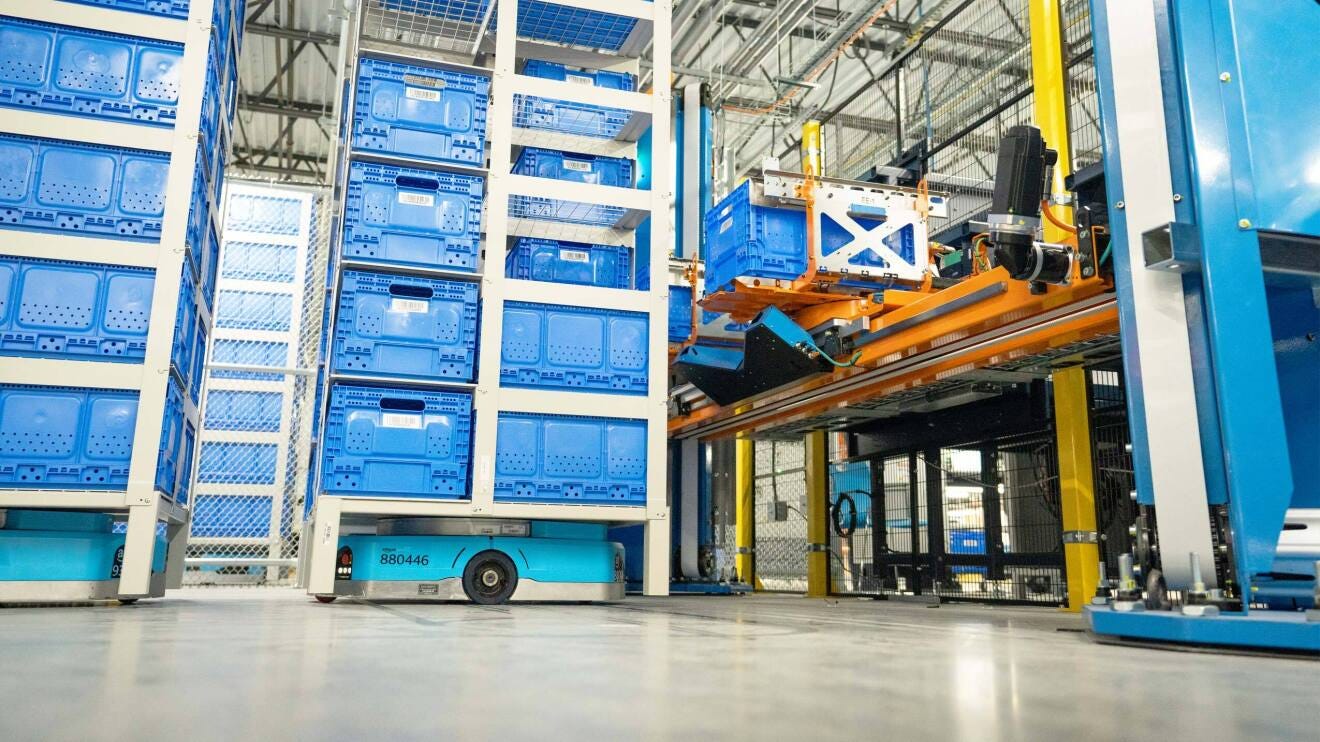
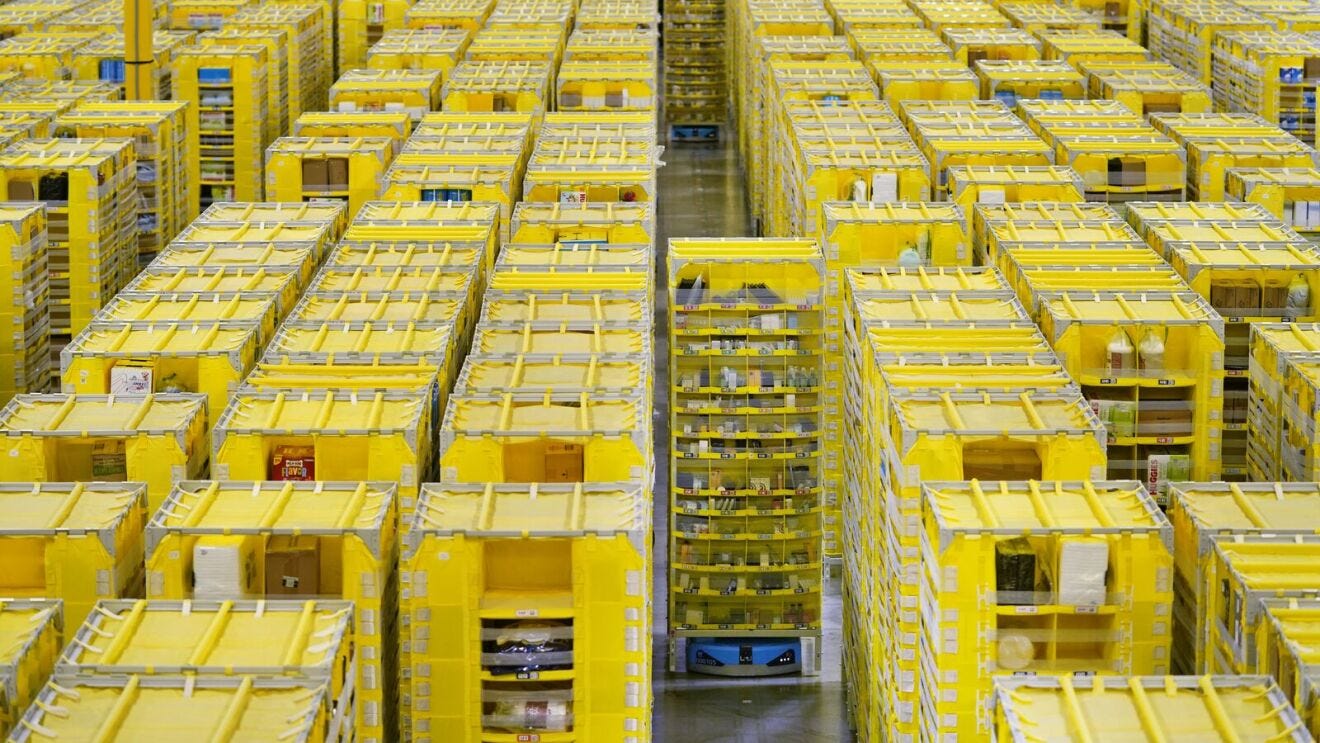
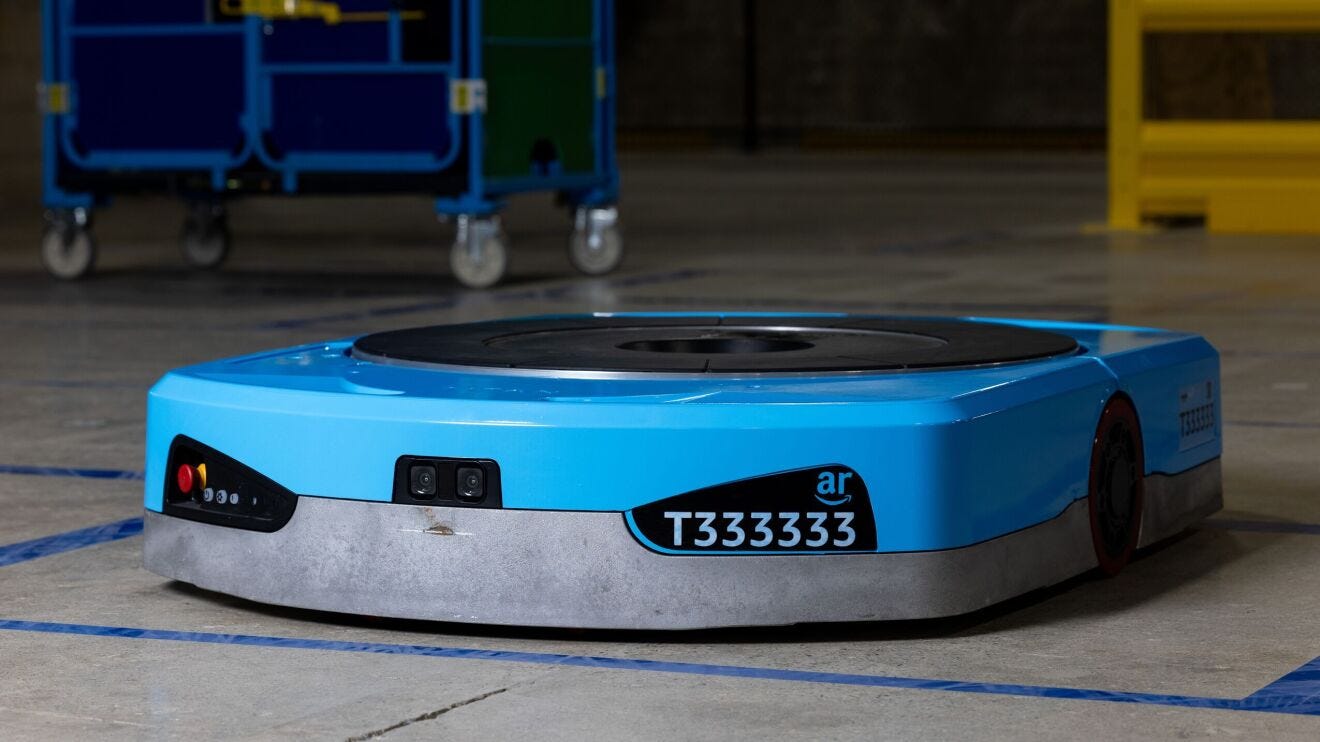
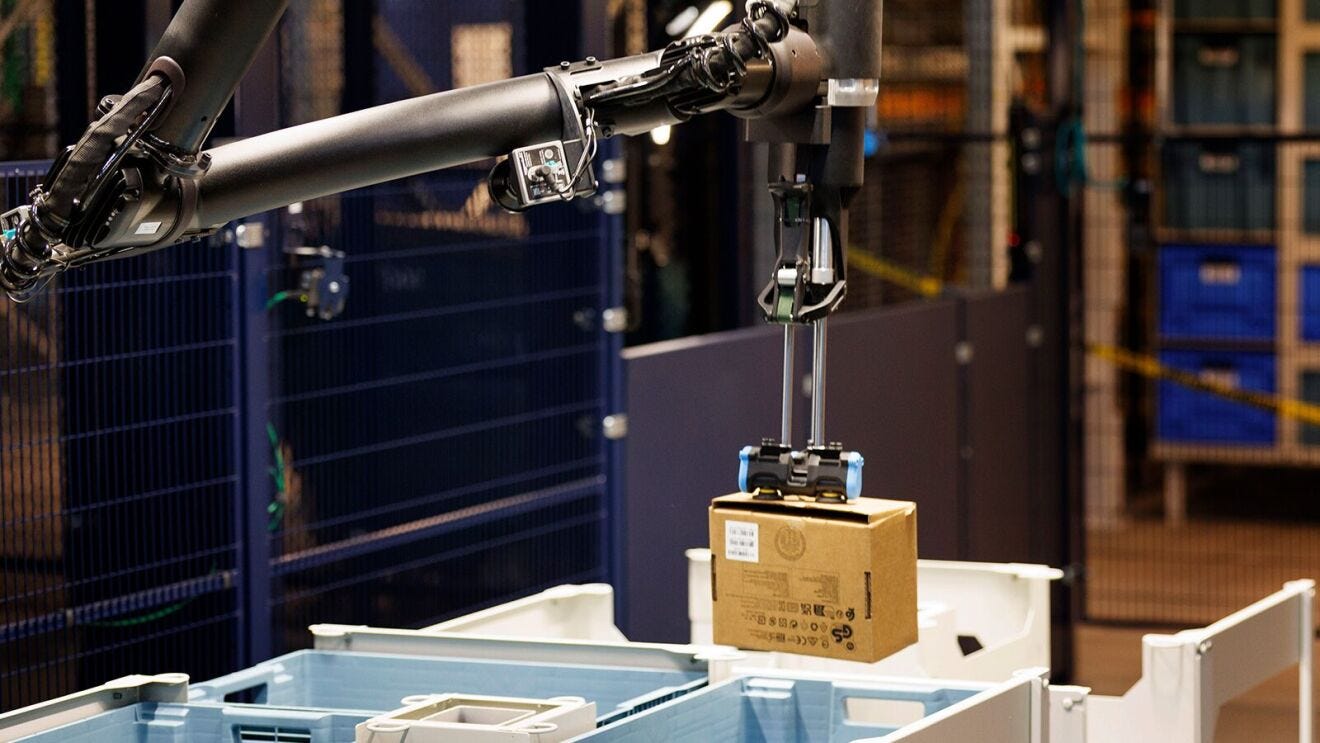
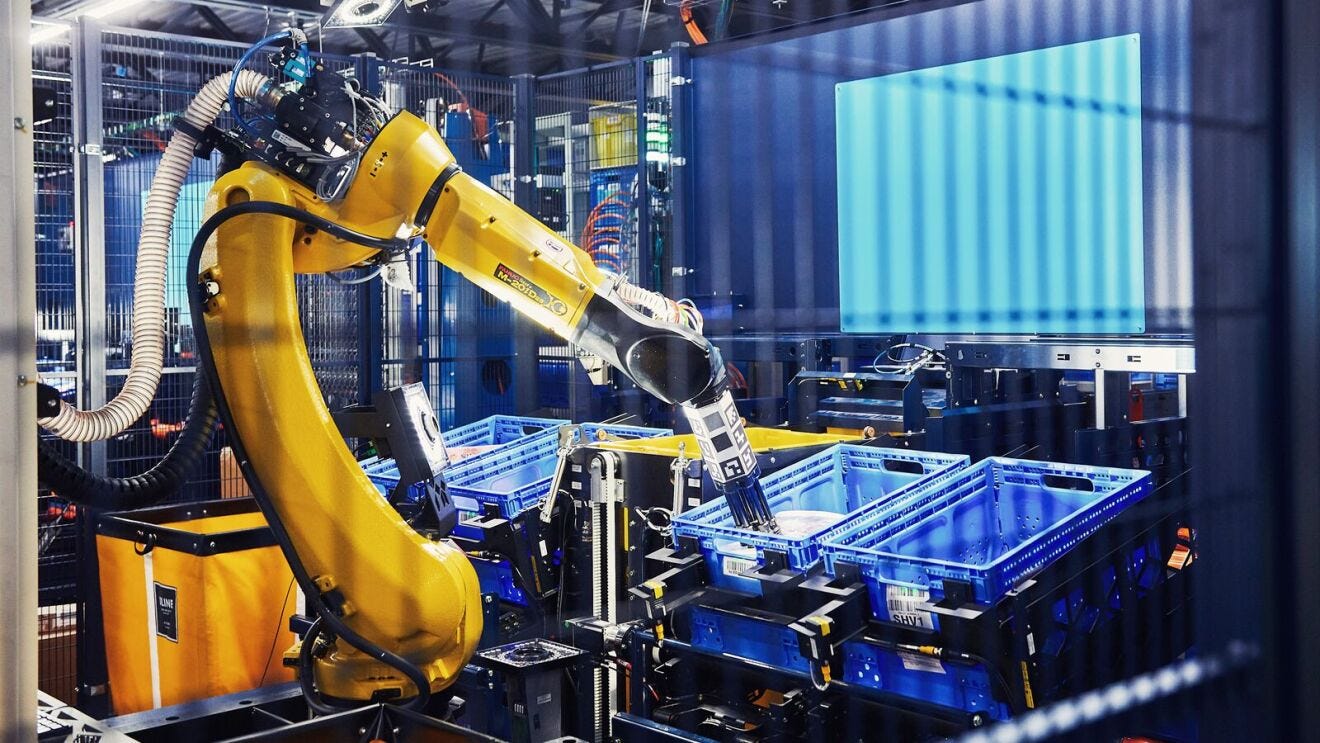
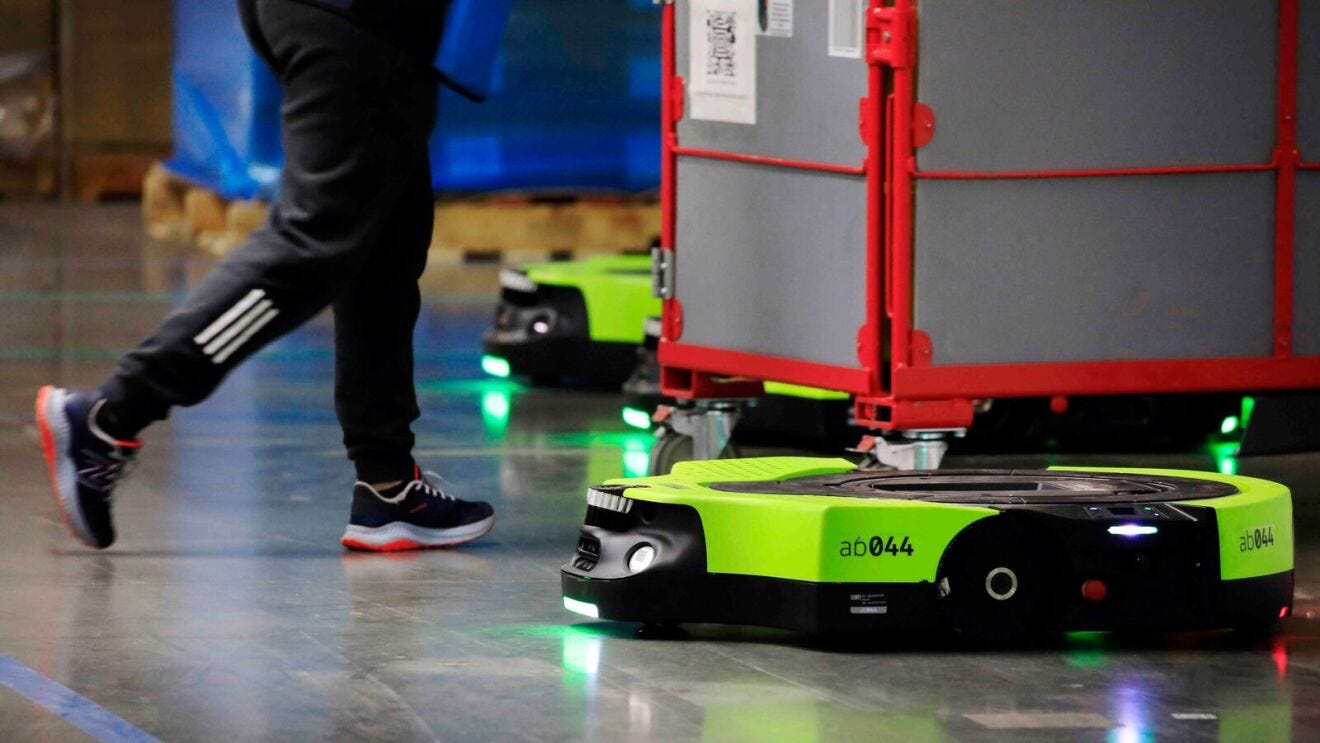
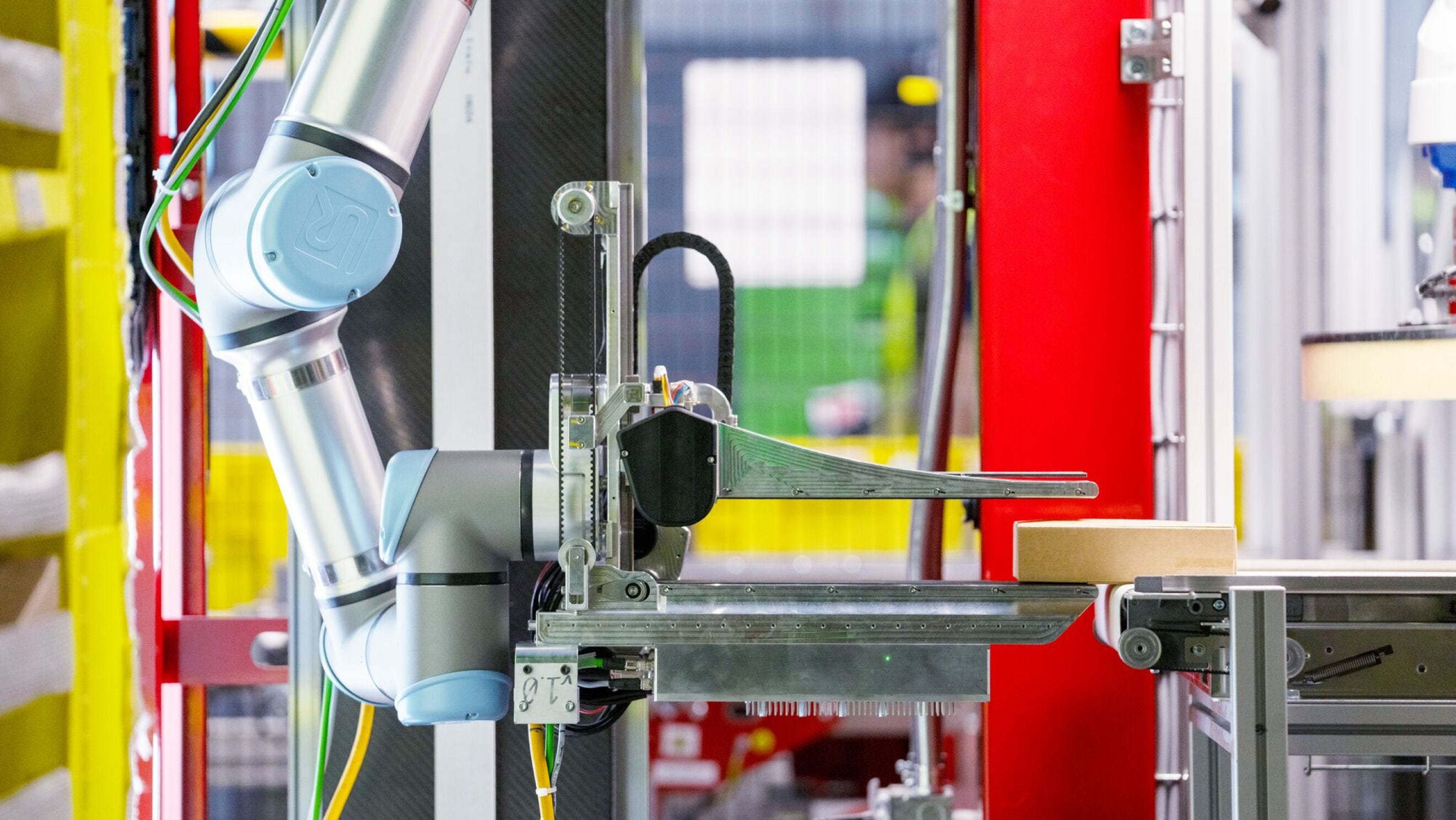
These are just a few of the robotics functioning in Amazon warehouses today.
I want to discuss one robot in particular, the Vulcan (pictured above). Vulcan is Amazon’s first robot with a sense of touch which represents a major leap forward in robotics and physical AI. Unlike traditional industrial robots that simply move or grip objects without feedback Vulcan can detect when and how it makes contact, how much force it’s applying, etc. This allows it to handle objects with far greater precision essentially mimicking the human sense of touch.
Vulcan is designed to pick and stow items within storage pods more efficiently and safely than previous systems. It can also use vision guided suction to pick out items with accuracy, avoiding mistakes like grabbing multiple objects at once. Currently, Vulcan can handle about 75% of the item types Amazon stores at speeds comparable to human workers while also knowing when to ask for human assistance for tricky items. Why is this so useful? It takes over tasks that require employees to climb ladders or reach awkwardly into bins which also reduces strain and injury risk.
The system was developed through years of research in force feedback, physical AI, and real world learning, training Vulcan on thousands of items to recognize how different materials react to touch. It continuously learns from experience. This is true embodied AI. Amazon plans to scale Vulcan across U.S. and European fulfillment centers over the next few years. This is the best robot Amazon has and is arguably the most useful, impactful, and advanced piece of robotic hardware in the world.
Amazon is undergoing the largest automation effort in history.
By 2033 Amazon expects robots to handle as much as 75% of all operations. That is an insane amount of automation. This would allow Amazon to avoid hiring hundreds of thousands of workers it would otherwise need even as shipment volumes grow. Internal projections show that by 2027, hundreds of thousands of roles could be eliminated due to this robotics effort. This shift is estimated to save $12.6B from 2025 through 2027 meaning those savings will flow directly into operating income and ultimately support higher EPS.
Much of this change will come from the continued rollout of the robotics systems I outlined above. These machines can pick, sort, and transport items more quickly than human workers. It also reduces the risk of injury and fatigue. A robot can’t get hurt, quit, or call out sick like a human can. We know the perception is bad but Amazon is well aware of the impending backlash. Leaked documents show that they’re actively avoiding using terms such as automation and AI.
One thing many aren’t mentioning is the potential for this to develop into a standalone business for Amazon. In my opinion, Robotics as a Service (RaaS) is the logical next step once these systems are fully proven in Amazon’s warehouses. Amazon’s fulfillment network is effectively an R&D lab that trains thousands of robots across real world conditions at a scale no other company can match. Once the technology is reliable, Amazon could start selling or leasing these same robotics systems to external warehouses, retailers, and logistics providers just like it once turned its internal cloud infrastructure into AWS.
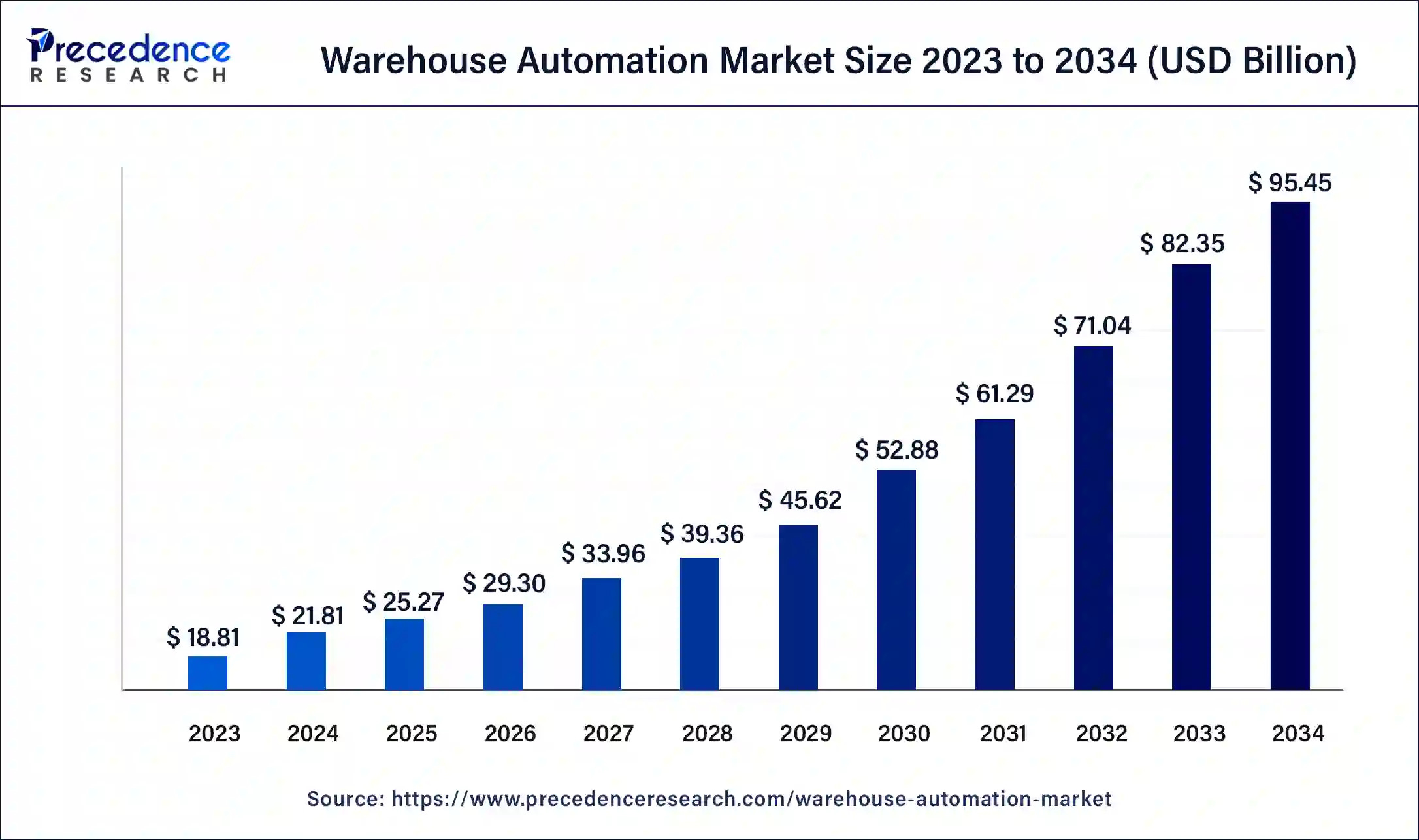
If Amazon packages its robotics hardware, AI software, fleet orchestration, and AWS analytics into a subscription model or package deal, the addressable market could be enormous. The global warehouse automation market is already projected to exceed $50B by 2030 and RaaS offers recurring high margin revenue similar to software rather than retail. A few ideas for these robotics systems include integrate predictive maintenance, real time analytics, and AI vision services powered by AWS. This would essentially create a complete “robotic logistics cloud.”
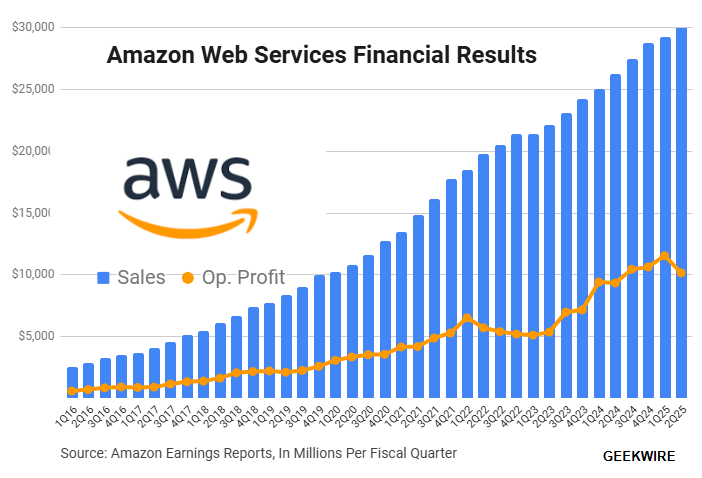
AWS started as just an internal cost center. In the early 2000s Amazon was struggling with scalability and efficiency across e-commerce. Every team was building their own servers, databases, and tools from scratch. Does that sound efficient? No. Around 2003, current CEO Andy Jassy led an effort to standardize all of those tools so Amazon’s workforce could work faster and more efficiently. It was originally meant to reduce costs and simplify internal operations.
Over time Amazon realized other companies had the same infrastructure problems. In 2006 they launched AWS publicly. As you can imagine the demand was massive and what began as an internal project quickly became one of the most important innovations in tech history. Today AWS makes up only a fraction of Amazon’s total revenue but generates the majority of their profit. Robotics could follow the same arc. The difference this time is the scale advantage, Amazon’s fleet of over a million robots provides unmatched training data, optimization insights, and economies of scale. If they decide to open that platform to others we could be looking at the birth of Amazon’s next multibillion dollar business line.
Here’s a list of a few AWS’ biggest customers:
Apple
Meta
Netflix
Disney
Zoom
Airbnb
Spotify
The NFL
Adobe
Maybe you’ve heard of them before..
The global robotics market is gigantic and expanding rapidly as automation moves from niche manufacturing into logistics, retail, healthcare, and everyday operations. Analysts project the total robotics TAM to exceed $500–600B by 2035 with warehouse and logistics automation representing one of the fastest growing segments. Warehouse automation alone is expected to surpass $60B by 2030! That’s at double digit annual growth. This segment covers mobile robots, robotic arms, automated storage systems, and full stack AI software. Sound familiar? This is exactly what Amazon has been building internally for over a decade and sounds exactly like what I mentioned above.
When you look at Amazon today it’s still operating with below 10% margins compared to Apple and Microsoft which consistently post 30%+ operating margins. You know what would help with that? Robotics. Every 100 basis point increase in Amazon’s margin adds roughly $10–12B in operating income. If robotics and automation help push margins 300-400 basis points higher, that’s an extra $30–40 billion flowing to the bottom line. At roughly $2.3T in market cap, I feel as if this is discounted when compared to Apple, Microsoft, and Nvidia trading over $4T valuations. Amazon could go up another 50% from here and still be cheaper than the three names I just mentioned.
Robotics is expanding rapidly across all divisions at the company. It ties directly into Prime Air with drone delivery that depends on automation at both the flight and packaging levels. It also connects to Amazon Pharmacy and One Medical where precise robotic handling can increase speed and efficiency. It even links with grocery logistics through Amazon Fresh and Whole Foods distribution hubs. The company is building an entire ecosystem where robots, drones, and autonomous trucks move goods seamlessly. Over time even humanoid robotics can contribute… imagine a robotic delivery assistant? We’re MANY years off from that, but that’s another automation lever Amazon could pull in the future to reduce costs. Imagine an autonomous vehicle with a delivery robot inside.
What makes this even more insane is the data flywheel behind it. Each piece of data is training Amazon’s systems. Every motion a robot makes, every object it picks up, and every path it takes generates data. Multiply that by over a million robots operating every day and what do you get? Amazon as the largest real world data generator for physical automation.
It’s not hard to picture what this will look like by the early-mid 2030s. What do I see? Warehouses run 75% by robots with humans overseeing exceptions or managing maintenance. Autonomous trucks and drones handling most deliveries. It sounds dystopian but you have to think bigger. Imagine if you told someone 25 years ago we could just pick up a phone and Facetime or Zoom with someone across the globe within seconds. Technology moves fast and goes further than most expect.
In regard to my Amazon position, I have no plans to sell after this earnings report. My plan is to hold and let the robotics thesis play out. I believe that by 2026 robotics will emerge as both a major market and societal theme as humanoid systems, drones, and autonomous vehicles gain traction and move into the mainstream media. Amazon could easily reach $300 per share which is right around a $3T market cap. I really don’t see why it can’t join the $4T club alongside Apple, Nvidia, and Microsoft which would put the stock closer to $400 per share. If there was ever a time to play some catch up, it’s now after last nights earnings report. Jassy mentioned that robotics is a major focus, and highlighted that AWS is seeing an acceleration in growth.
Everyone knows this, but Amazon isn’t just e-commerce and retail. It’s cloud computing, robotics, grocery, logistics and fulfillment, AI and machine learning, streaming and entertainment, advertising, consumer electronics, health and pharmacy, data analytics, fintech and payments, music, and more. Amazon touches more areas of daily life and global infrastructure than any other company on Earth, it’s multiple businesses under one umbrella.
Thank you for reading. I’m currently working on a detailed robotics piece where I’ll discuss every major player in the space, break down the broader robotics landscape, and highlight the most important stocks to watch across each segment (not just the small cap momentum names you see all over X). It’s a good one.
Have a great night!
By reading or acting on any content in this newsletter, you acknowledge and agree to the following terms of service.
I am not sure it's fully comprehendible how fortunate we are to have you providing these write ups.
Thank you, friend.
Beautifully written and an easy to absorb piece Za. Holding at the moment, this definitely makes me want to add on market dips. 👏