
Elon Musk's $1 Trillion Bet: The Next Chapter of Tesla

The vote is official.
Tesla shareholders have approved what will go down as the biggest executive compensation package in history. One that could make Elon Musk the first trillionaire.
Elon has called this not just a new chapter for Tesla, but a new book. The numbers are hard to process when you look at them. It’s a 10 year performance plan worth up to one trillion dollars in Tesla stock if a long list of targets is met.
For the past few years, people have questioned Elon’s commitment to Tesla. He’s the CEO of multiple companies including other hundred billion dollar companies such as SpaceX and xAI. He was also a government employee for a short period of time and spent his Summer of 2024 working to get Donald Trump elected. But now there is no questioning his commitment because he has to succeed on a laundry list of incentives, or he’s paid nothing.
The time for Tesla to enter its next stage of growth is here. And Elon now has every incentive shareholders could possibly ask for to lead it.
Tesla CEO Elon Musk’s Compensation Package (2025–2035)
Market Cap + Operational Milestones (12 tranches total):
$2.0 trillion market cap: 20 million total vehicle deliveries
$2.5 trillion market cap: 10 million active Full Self-Driving (FSD) subscriptions
$3.0 trillion market cap: 1 million humanoid robots (Optimus) delivered
$3.5 trillion market cap: 1 million robotaxis in commercial operation
$4.0 trillion market cap: $50 billion adjusted EBITDA
$4.5 trillion market cap: $80 billion adjusted EBITDA
$5.0 trillion market cap: $130 billion adjusted EBITDA
$5.5 trillion market cap: $210 billion adjusted EBITDA
$6.0 trillion market cap: $300 billion adjusted EBITDA
$6.5 trillion market cap: $400 billion adjusted EBITDA
$7.5 trillion market cap: valuation milestone only (no operational target)
$8.5 trillion market cap: final valuation milestone (no operational target)
For reference, Nvidia’s trailing twelve month (TTM) EBITDA isn’t even $100B yet. Tesla needs to be 4x higher than that for Elon to get paid the final EBITDA based tranche.
Structure & Key Details:
12 tranches of restricted stock units (RSUs): vesting only when both market cap and operational goals are hit.
No salary or cash bonus: 100% performance based equity.
Vesting period: spans 10 years (2025–2035).
If fully achieved, the package could be worth: $1T.
Would increase Musk’s total Tesla ownership to: roughly 28–29% of voting shares.
When the shares can be sold: not immediately after vesting.
Why this massive pay package:
This pay package ties Musk’s financial rewards directly to the success of Tesla’s next phase of growth. If Tesla fails, Elon gets literally nothing.
What is that next phase of growth?
Autonomy (Robotaxis, FSD platform, software licensing)
Robotics (Optimus humanoid robot)
Energy generation & storage (Megapack, Powerwall, Solar)
Under the terms of the deal, Elon earns no salary. Every dollar will come from the performance of Tesla stock and the overall business performance. Yes he has plenty of stock he can borrow against but that’s besides the point. He’s the only big tech CEO who doesn’t have a base salary. Apple, Microsoft, Nvidia, Meta, Google, and Amazon all provide a base salary to their CEOs. Not Tesla.
For years Elon has framed Tesla’s mission as “accelerating the world’s transition to sustainable energy.” That used to mean EVs and solar panels. Tesla was the first electric car I remember seeing, and it’s still by far the most popular electric car I see on the roads today. There is really nobody close. After the vote today, the story has officially shifted. At the shareholder meeting, Elon said Tesla’s mission is to create “abundance for all.”
What does that mean?
Abundance of energy:
Tesla long term energy goal is to make clean, renewable power cheaper and more widely available than fossil fuels ever were. How? Through solar, Megapacks, and grid storage.Abundance of labor:
With Optimus and robotics, Elon wants to decouple productivity from human physical effort. He believes humans should be able to live how they want and do what they want, when they want. Will this next phase of AI lead to UBI? It could, but that’s a topic for another time.Abundance of transportation:
Fully autonomous vehicles and robotaxis could make mobility as cheap and ubiquitous as internet access. There are many people who would benefit from this type of transposrtation whether it’s the elderly, disabled, or those who just can’t afford a car.
It’s possible for Tesla to contribute to this vision Elon has set forth. Tesla is becoming the operating system for embodied AI. All of their AI models are trained on real world data. Cars collect data through every mile driven, feeding Tesla’s massive real world learning network, robots act as mobile computing units, turning that intelligence into physical action, energy products serve as the power supply, and AI software functions as the brain connecting it all into one self learning constantly improving system.
Autonomy, Tesla’s AWS Moment:
Elon has compared autonomy to AWS. Just as Amazon’s true profit driving breakthrough wasn’t retail but cloud computing, Elon thinks Tesla’s automotive future won’t be defined by selling cars that humans drive. It will be defined by what cars can do when no one is driving them.
Tesla’s Full Self Driving (FSD) program has already logged billions of autonomous miles. Over 3 billion to be exact… do you know how much data that is? For comparison, Waymo has 100 million miles of data.
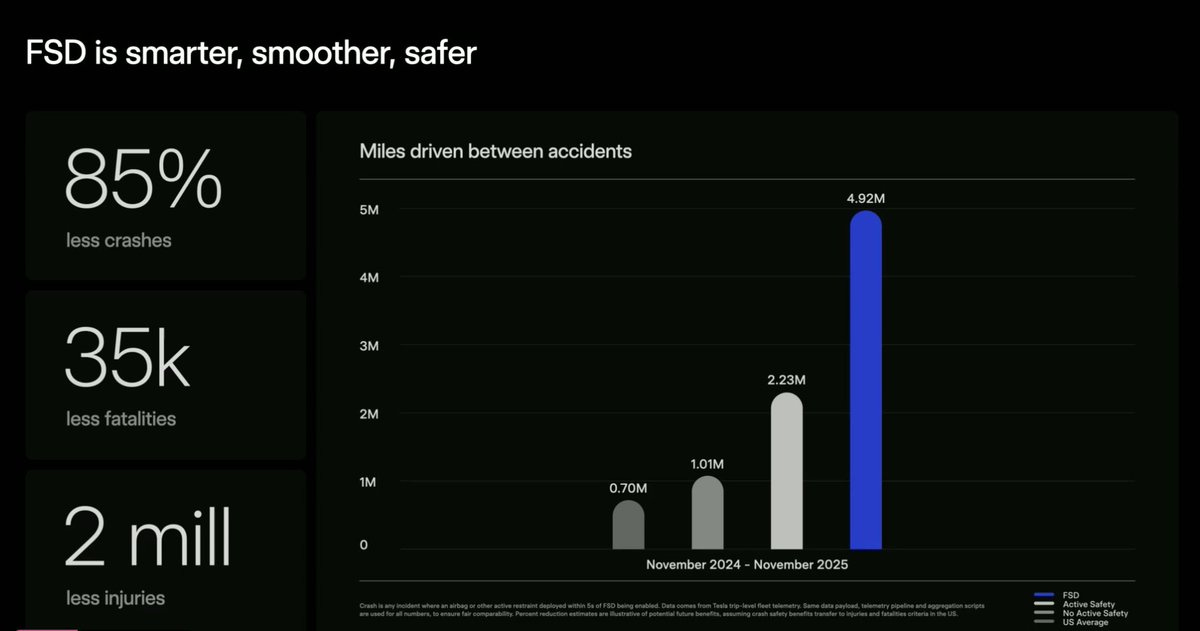
I have personally tried Tesla FSD on numerous occasions, it’s mind blowing stuff. It feels like you’re driving in the future. Tesla has shown early versions of its Cybercab which it plans to begin producing in 2026. Yes we all know he’s often late, but regardless, the Cybercab is coming.
What makes this so powerful is not just the technology but the freedom it creates. Commuting hours can be used as free hours. People will be able to work, read, sleep, or do nothing while traveling safely to their destination. The concept of car ownership will likely start to shift too. Autonomy will eventually change transportation from a product to a service.
In my opinion the service potential goes even beyond robotaxis. The same autonomy software can power delivery vehicles, logistics systems, and machinery. Tesla could eventually license its autonomy platform to other automakers (this has been hinted at on numerous occasions already), creating a recurring stream of high margin revenue that scales without building more factories. Software is a much higher margin business than software…. this is a textbook potential AWS moment.
R2D2 and The Robots:
The other major pillar of Musk’s new plan is robotics. One of the explicit targets in the pay package is to sell one million humanoid robots.
Early prototypes of Optimus are now capable of dexterous hand movement and walking stability. Videos from Tesla’s facilities show Optimus units sorting parts, handling tools, and even working alongside humans. Even if some of them are being tele-operated, they’re still being trained on the movements and tasks being completed.
Here’s a snippet from Goldman Sachs on the humanoid robotics TAM by 2035:
“Should the hurdles of product design, use case, technology, affordability and wide public acceptance be completely overcome, we envision a market of up to US$154bn by 2035 in a blue-sky scenario. A market that size could fill from 48% to 126% of the labor gap, and as much as 53% of the elderly caregiver gap.”
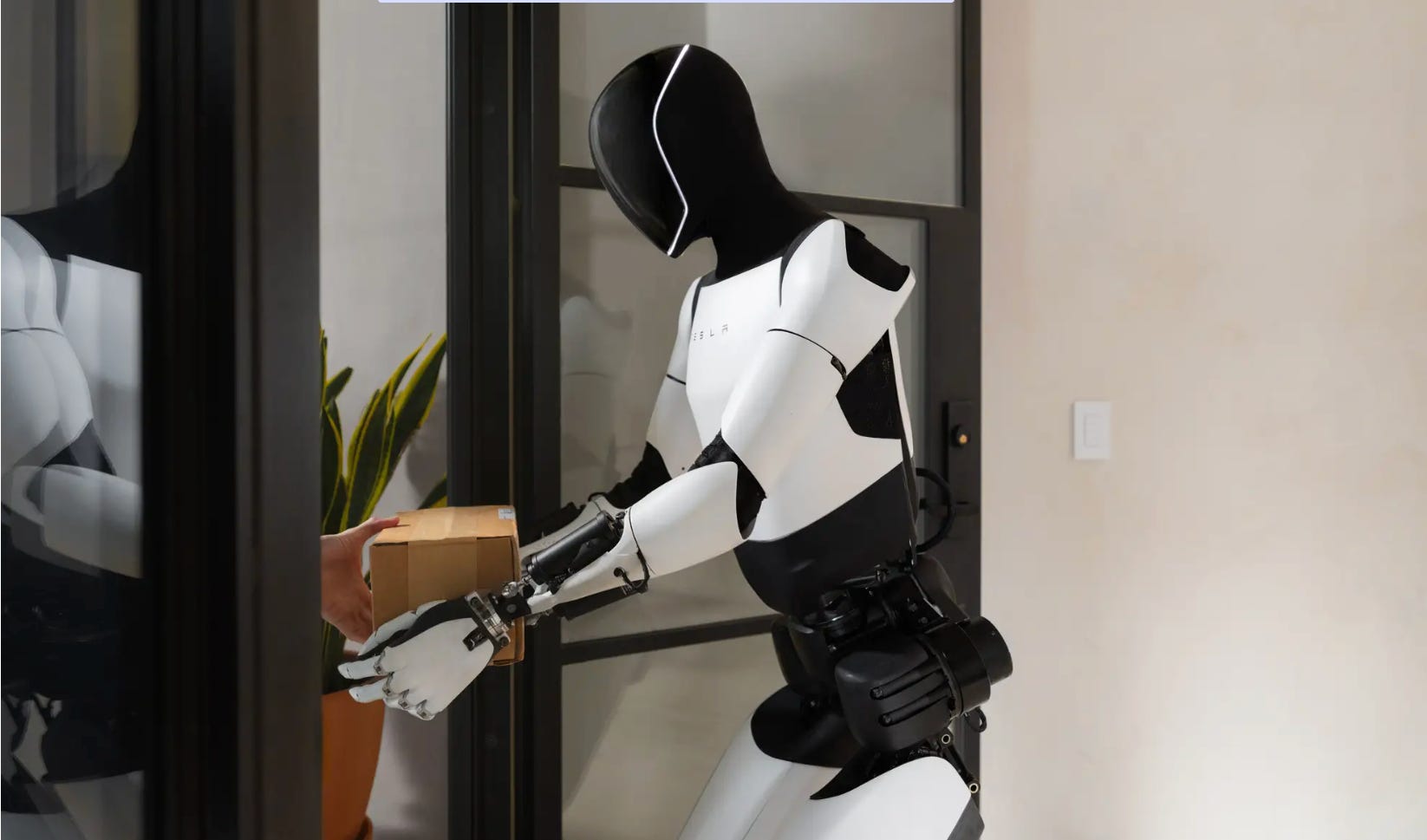
The thesis is relatively simple… labor shortages, aging populations, and rising productivity pressures will increase the need for robots.
Elon continues to refer to Optimus as the most important product in history. Bigger than the iPhone… and he might be right. When the iPhone first came out, it was very difficult to project the impact it would have. You can say it was obvious but if that was the case, everyone would have bought Apple stock and been rich. There just aren’t many people who were buying Apple stock at $5 in 2007.
The Energy Revolution:
The robots and autonomous vehicles catch the headlines and get all the attention, but arguably the most underrated aspect of Tesla is the energy business.
Tesla Energy includes the Powerwall, Megapack, and Solar Roof products which together form a distributed global power grid. This division quietly became one of Tesla’s fastest-growing revenue segments in 2025, generating over $3 billion in quarterly sales and boasting gross margins above 25%.
As we’ve seen in the stock market as of late, energy isn’t just a side business.. it’s actually the building block that robotics, autonomous vehicles, etc. will be built on. Look at all the data centers being built… they all require massive amounts of energy.
Elon has said numerous times, if Tesla is going to power fleets of robotaxis, data centers for AI training, and millions of humanoid robots, they need control over power generation and storage. They don’t want to outsource anything to anyone, they’re a vertically integrated machine.
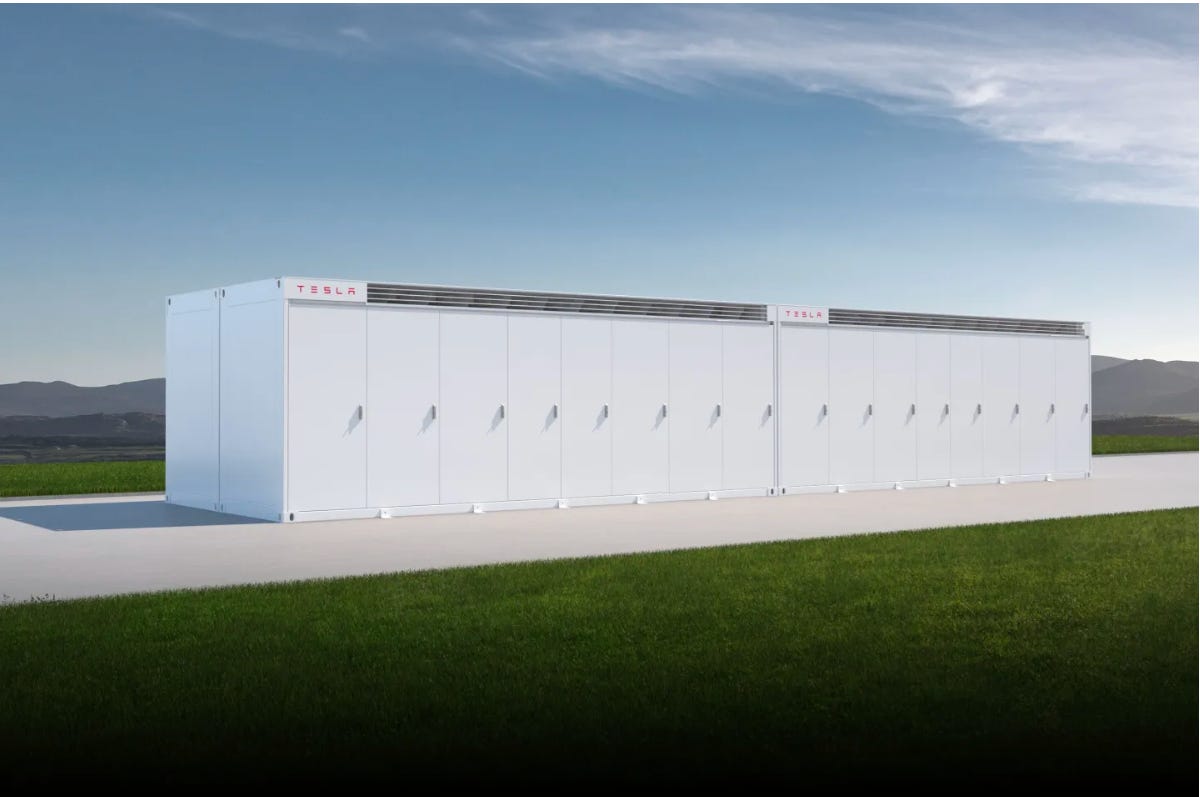
Each Megapack can store enough energy to power thousands of homes. Tesla has already deployed massive battery farms across California, Texas, and Australia, stabilizing grids and generating recurring revenue from utility contracts. At some point I think we’ll start to see Tesla involved in data center energy. It feels like it’s just a matter of time… what company is better positioned to take advantage of this massive need for energy?
Another underrated aspect of Tesla energy is the Autobidder platform. This allows Megapacks to autonomously trade electricity on energy markets and turn batteries into profit centers. This combined with global solar expansion positions Tesla to become a legit energy player.
The Brains:
Elon wants to control everything. Yes, even the chips. That’s why he’s manufacturing his own chips and not to replace Nvidia, but to supplement them. Their latest chip is called AI5. He described AI5 as likely to be the best inference chip in the world for models under roughly 250 billion parameters. The chip aims to achieve the highest performance per watt while keeping manufacturing costs low. It will be produced by both TSMC and Samsung using advanced fabrication processes with mass production expected to begin toward the end of 2026.
AI5 is rumored to deliver between 2,000 and 2,500 trillion operations per second, this is a major leap over Tesla’s current system. This improvement is crucial for enabling real time processing of complex environments, better decision making for self driving cars, and faster neural network inference for Optimus. Basically everything physical AI.
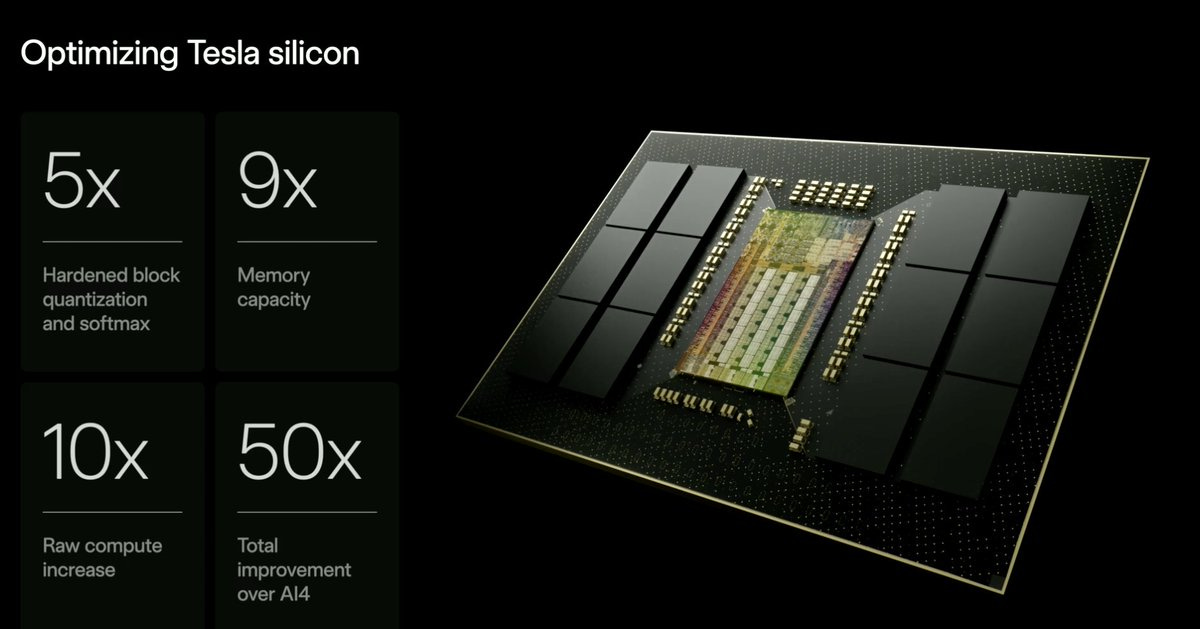
This chip could be used in robotaxis, in Optimus, and even in energy products that use AI to balance and optimize grid systems. By designing their own chips Tesla can tailor hardware precisely to its software stack which creates performance advantages and reduces reliance on third party suppliers.
Yes the chip’s success is not guaranteed. Manufacturing custom silicon at such advanced nodes presents major challenges in yield, cost, and supply chain logistics. But… if AI5 performs as promised, it could be the foundation for Tesla’s next group of products enabling full autonomy, robot labor, and intelligent energy networks.
What It Means for the Stock:
Let’s put the target in perspective.
To reach an $8.5T valuation, Tesla would need to be roughly 70% larger than Nvidia, the current global leader in market cap. It sounds crazy. But that’s the entire essence of the Musk era… everything sounds crazy. In 2012 Tesla was on the brink of bankruptcy and in 2018 analysts mocked the idea of a $50 billion valuation. Today it’s the most valuable automaker in history and one of the top ten companies by market cap in the world. My bet is on things getting even more crazy over the next few years as AI adoption accelerates.
The Flywheel:
Other companies train AI models in simulation or with very limited data. Tesla’s models learn from billions of real world miles driven by its global fleet.
Tesla’s approach to embodied AI is unique because it connects the digital brain to the physical body. The same brain that powers Full Self Driving in cars is being adapted for Optimus. That means the same visual understanding, spatial reasoning, and motion control that enables a car to navigate a city can allow a robot to navigate a warehouse or a home. Every improvement in one system improves the other. This creates exponential learning across products.
Tesla’s most powerful advantage is the way all of their products reinforce each other.
The more Tesla grows the faster the flywheel spins:
EVs generate cash → funds R&D for robots and energy storage.
Robots and FSD collect data → improve AI models which makes robots and autonomous vehicles products smarter.
Megapacks and solar power → provide cheap and reliable energy to manufacture and power their robots and autonomous vehicles.
The Bear Case:
Now, I obviously don’t believe in the bear case as I own the stock. But I still think it’s important to discuss the bear case.
The package gives Musk near total control of Tesla. This has raised concerns about governance and accountability.
The $8.5 trillion market cap target is seen as unrealistic and requires dominance in multiple industries simultaneously.
Issuing that much equity could heavily dilute existing shareholders while concentrating all of the wealth to Elon.
Elon is often late to his “promises” and ideas.
Waymo has a big lead in footprint.
The valuation is extreme for an automaker.
I am not concerned about any of the above. I believe Elon genuinely wants Tesla to succeed and he now has $1T hanging over his head. The market cap is extremely high, it’s basically double what Microsoft is worth today. You have to think, if someone told you 5 years ago that Nvidia would be worth $5T you’d probably laugh. Don’t say you wouldn’t because if that’s the case everyone would own the stock and be up 1,200% over the last 5 years….
Waymo absolutely has a larger footprint when it comes to deployment zones (the number of cities where its robotaxis operate under approved conditions). But footprint isn’t the same as intelligence… Waymo’s system is limited by strict geofences and heavy reliance on pre mapped routes. It’s impressive in its own right of course, Google is a fantastic company. But it doesn’t scale as easily around the country because it depends on curated environments. Tesla’s approach is fundamentally different… Tesla isn’t training autonomy for one city or one region. FSD is learning to drive anywhere.
In terms of valuation, everyone understands and realizes Tesla is an expensive stock on traditional fundamentals. Tesla has always been valued like a call option on the future of AI. Investors are pricing in autonomy, robotics, energy, and AI. Not just car sales. I believe Tesla will grow into its valuation with autonomy and robotics.
In Conclusion:
The vote is done and the pay package is officially approved, Elon has entered a new era with Tesla. Tesla is perfectly positioned for the embodied AI era, it’s on Elon to pounce on the opportunity. I think there’s a shot Tesla is the most valuable company in the world someday…
This is by far the craziest performance plan ever formed and it’s fitting that it belongs to the “craziest” CEO since Steve Jobs. Whether you love him or hate him you can’t deny the scale of the bet.
The next chapter of Tesla has officially begun.
Disclosure:
I own a position in Tesla stock.
So well written. Thank you
This comp package is defintely ambitious, but tying it to preformance metrics makes sense for shaeholders. Elon's track reecord with SpaceX and the first Tesla comp plan show he can actually deliver on these moonshot targets.