
The Hardest Part of Trading & Investing: When to Sell

Nobody ever talks about when to sell.
Everyone wants to know what to buy, when to buy, and how much to buy, but the most difficult aspect of the transaction is deciding when to exit. Buying is exciting but the truth is we don’t make any money until we sell.
Selling is the hardest part of trading and investing. It makes us emotional and uncomfortable because it forces you to face the reality that the gains we see are only on paper until we click the sell button. You can have a perfect entry but if you don’t know when to sell, profits can disappear quickly.
I wish it was easy as saying “when x happens that means you sell right away” but it’s just not how this game works. There are a multitude of factors that go into selling, it’s a big decision that can leave us doubting ourselves regardless of the route we decide to take. If we sell and it goes higher, we’ll feel regret. If we don’t sell and it goes lower, we’ll feel regret. It’s a game of imperfect decisions and no matter what we do, hindsight will always make us feel like we could’ve done better. The truth is, there’s almost no perfect sell. The only thing we can control is making consistent, rational choices that protect our capital and keep us in a position to win long term.
Before getting into this educational article, I want to highlight the four I have posted already:
My plan is to release one of these each week. I’ve got a long list of topics lined up including the psychology of trading, how philosophy fits into the mindset of a trader, how to effectively use moving averages, buying within a base before a breakout, identifying ideal entries during uptrends, and more. If there’s something specific you’d like me to cover, drop it in the comments. I read everything and I want these to be useful. The goal with this series is to build something long lasting that helps all of us think sharper, trade cleaner, and approach the market with more discipline.
Below, I’m going to walk through exactly what I look for when I’m deciding whether to sell a trade or a long term investment. It’s never an easy call because every decision to sell carries a mix of logic and emotion, but over time I’ve built a framework that keeps me grounded.
Let’s start with investing.
If I make a long term investment, my mentality is that I would like to hold the possible for as long as possible. Ideally many years. Reality is this sometimes isn’t how it works out due to a plethora of issues that could change the thesis.
Every long term position should be built around a thesis. What’s a thesis on a long term investment? In my head, it’s as simple as answering “why am I buying the stock?”. You should be able to come up with a clear set of assumptions about why the company will grow, how it will execute, and what catalysts will drive value over time. If you can’t articulate a strong thesis in a stock you plan on owning for a long time, it likely means you haven’t done enough work and you shouldn’t own the stock. I see this often today. People like to follow others into trades or investments. Following someone else’s idea without doing the work yourself is how you end up going crazy during volatility because you haven’t built your own conviction. Always ensure you have built your own thesis on a stock, regardless of what anyone else says.
The hardest sell decisions are the ones that force us to admit we were wrong. Maybe we believed a certain narrative about growth, the business model, etc. that just isn’t coming to fruition. If the thesis is broken or our thesis isn’t strong enough, it’s best to move on. The market doesn’t reward us extra for sitting in a stock we don’t believe in because we don’t want to admit we were wrong. It rewards adaptability. I do not have a laundry list of reasons to sell a long term investment because I give my long term investments some leeway. If I bought in the first place, it means I have a strong thesis. It takes something major for me to sell. Below are a few flags that could change my thesis on a company, leading me to sell.
1. Changes in Management
Leadership drives the overall direction of a business. All of my long term investments have a leader at the helm who I trust and believe can deliver on the mission. When management changes it often signals a problem underneath the surface. Not always, but often. The DNA of the company changes when the CEO leaves. A great CEO can completely alter the trajectory of a business, just like a poor one can destroy it.
If you bought into a company because you trusted the team’s vision and that team leaves or is replaced, you have every right to reassess your investment. Sometimes the new CEO is someone who has been with the company for a long time and has a proven track record, that can work out. A new CEO doesn’t automatically mean sell, but it does mean you’re now betting on a new set of unknowns. Sometimes new leadership can unlock value but in my experience, it’s a red flag that something’s wrong behind the scenes. Why would a CEO leave a company he believes in? They always frame it in a positive manner, whether it’s “taking a break” or “a career change” but reality is nobody leaves their position as CEO making millions unless something major changes.
This is especially important in smaller and mid cap companies where the founder or early management team is deeply tied to the company’s identity. For me, a management change always triggers a full re-evaluation of the position. Management changes aren’t always a reason to sell, but they’re a red flag for me and always lead to me strongly considering whether or not I still want to own the company.
2. Worsening Earnings
I can forgive a bad quarter but I can’t ignore a trend. If earnings start deteriorating consistently, I have to reassess my position. Stocks follow earnings over the long run. A company’s multiple might expand or contract in the short term but over time, performance always converges toward fundamentals.
“In the short run, the market is a voting machine but in the long run, it is a weighing machine.” - Benjamin Graham
When I see earnings start to worsen, I dig into why. Is it cyclical or structural? A temporary margin squeeze due to expansion is one thing. A consistent decline in profitability, revenue, etc. because the company can’t scale is a whole other story. Long term investing doesn’t just mean blind loyalty and “hold forever” because it’s called long term investing. If a company performs worse than expected, I have no issues exiting.
3. Better Opportunities
Capital is finite but opportunity isn’t. Sometimes we sell not because something’s wrong with your current position, but because we find something better.
This is a hard decision to make. Sometimes we sell one stock to buy another one and the one we sold continues higher. That’s just part of the game, we have to live with those mistakes if we trust our process. Investing is always relative with risk vs. reward and return vs. opportunity cost. If I see another name with a stronger growth trajectory or a name I think would fit better in my overall portfolio, I’ll make the swap. This is very rare for me but it is something I’ve done.
This is where ego can get in the way because people fall in love with their stocks. I’m guilty of this too, we fall in love with the narrative and the story. But the stock market doesn’t care how long we’ve held or how loyal we’ve been. The only question that matters is: where is your money working hardest for us right now?
4. Legal Issues or Fraud
These are two instances where I don’t ask questions, I just get out. There are far too many stocks to own that don’t have legal issues or fraud concerns to be stuck in one that does have these issues.
A company like Super Micro Computer is a great example of this. I didn’t own it but I know people who did and once the wave of fraud came out, it ruined their confidence. Especially because the company had a long history of it as well, this wasn’t the first rodeo of Super Micro having sketchy accounting. The earnings can be great and the stock can run but once the fraud allegations hit, the music stops. Everyone loved SMCI, it was the Robin to Nvidia being Batman. But then we got rumors of fraud and a ton of other problems it crushed momentum and to this day the stock hasn’t been able to recover, despite growing earnings. Nobody can trust the earnings anymore, so the stock doesn’t see momentum like it used to.
It’s an easy sell and move on when we see these types of issues in a company.
These are the four reasons I may opt to sell a position in my long term account. Some people could have mentioned something like valuation but if I’m planning to hold a stock for a long time, they’re executing, there are no legal issues, and management is strong, I am willing to hold the premium. There’s plenty of bad stocks, if a stocks valuation is the only reason I want to sell then I don’t think the justification is good enough. I also don’t like to “take profit” randomly on a long term position. I have found that this actually has harmed my ability compound gains… if the thesis hasn’t changed, I want to continue owning it. It’s really that simple for me!
Now, I find selling in trading to be a bit easier. I do not have a list of sell rules I follow because I strongly believe each stock and each trade should be managed depending on the stock, the sector, the move, the environment, etc.
I do keep a set of parameters I watch such as things that consistently help me gauge when momentum might be fading, but I don’t have a blanket rule like “if X happens, I’m out” that applies to every single trade. I might have that kind of hard stop or trigger for a specific trade, but it’s always contextual. Sometimes I’ll give a name more room because the sector is strong or the stock is volatile. Other times I’ll tighten up a bit. Trading is a fluid game, we should all be fluid as well!
1. Weekly close below key moving averages
When a stock that’s been trending strong finally closes below its 10 or 20 week EMA, that’s the first major signal momentum is slipping. I call these moving averages guardrails during a healthy uptrend. They essentially act as clean support areas that should not be broken. The strongest trending names ride these moving averages for weeks or even months as buyers consistently step in around them. Once the stock starts closing below those levels on the weekly, it’s a red flag.
The 10 and 20 week moving averages are often the last line of defense, a weekly close below there often indicates the trend is over.
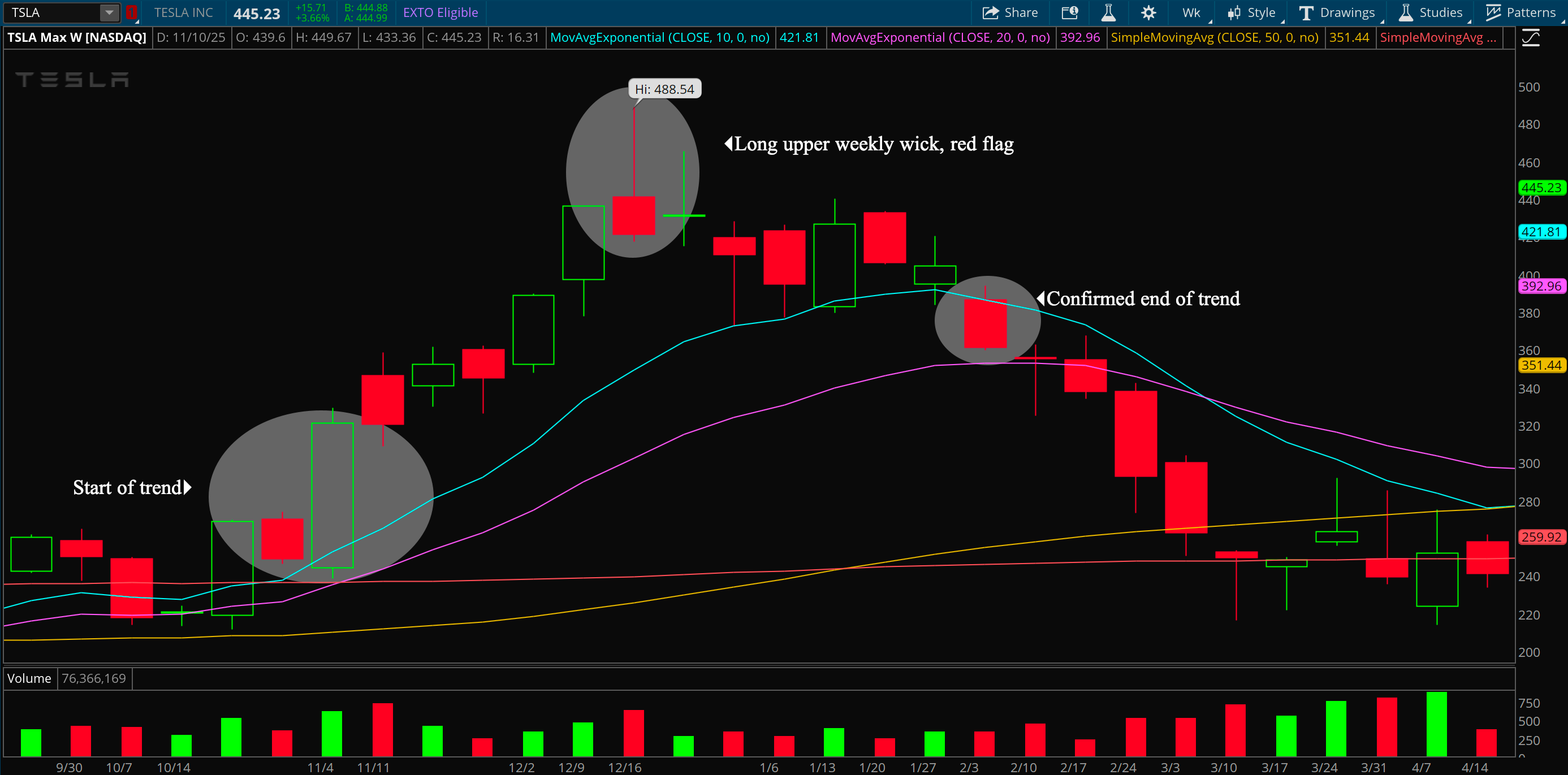
You can see with Tesla above, once the 10 week moving average (blue line) broke down the trend was essentially over. The bigger signal was the long weekly wick at the top of the trend, but you get the point. Even if you didn’t sell the top and instead sold the weekly close below the 10 week, you would have missed another 35-40% in downside. Remember, you do not need to buy the bottom or sell the top.
2. Weekly close below a breakout or base
When a stock breaks out of a base it’s often a buy signal. When it shows a false breakout, that shows breakout buyers are trapped and a new level of resistance was formed. Or bagholders so to speak. When price closes below a breakout area on the weekly chart, the means breakout failed. The buyers who came in at that level are now underwater and that shift in psychology can flip the chart completely. Those same buyers likely turn into sellers on bounces into that range and that change in behavior can kill an entire move.
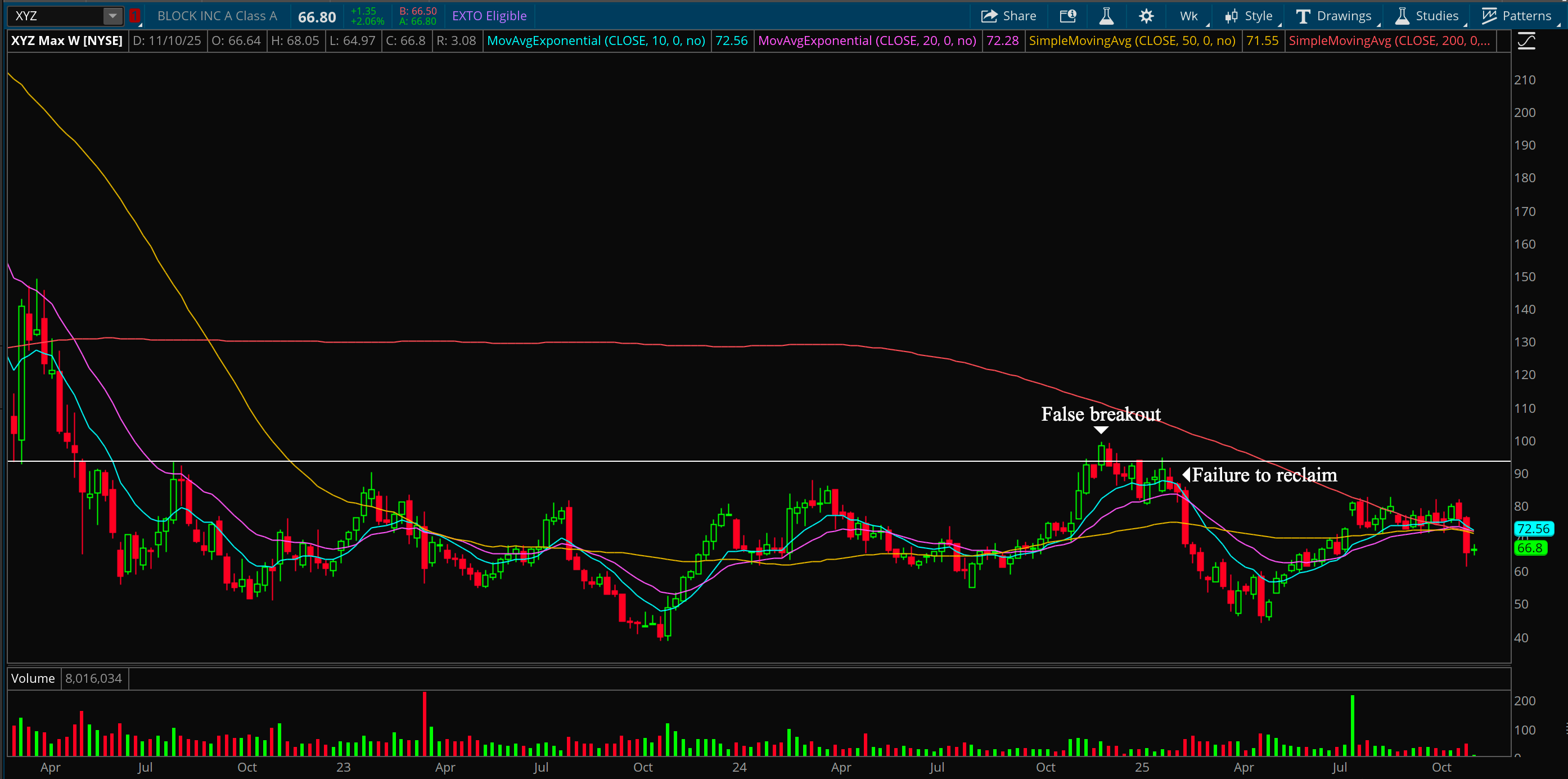
I was very bullish on this setup and it ultimately failed. I got out after a few weeks of the stock trying to reclaim the breakout area and good thing I did! I avoided nearly 50% further downside. False breakouts are very strong sell signals.
3. Long Upper Wick Near The Top Of a Run
You see this constantly near the end of powerful uptrend. A weekly candle that looks like an inverted hammer, or “gravestone doji” some call it. That long upper wick tells you everything you need to know… buyers pushed it up early in the week but sellers took control by the time the candle closed. I view that as exhaustion.
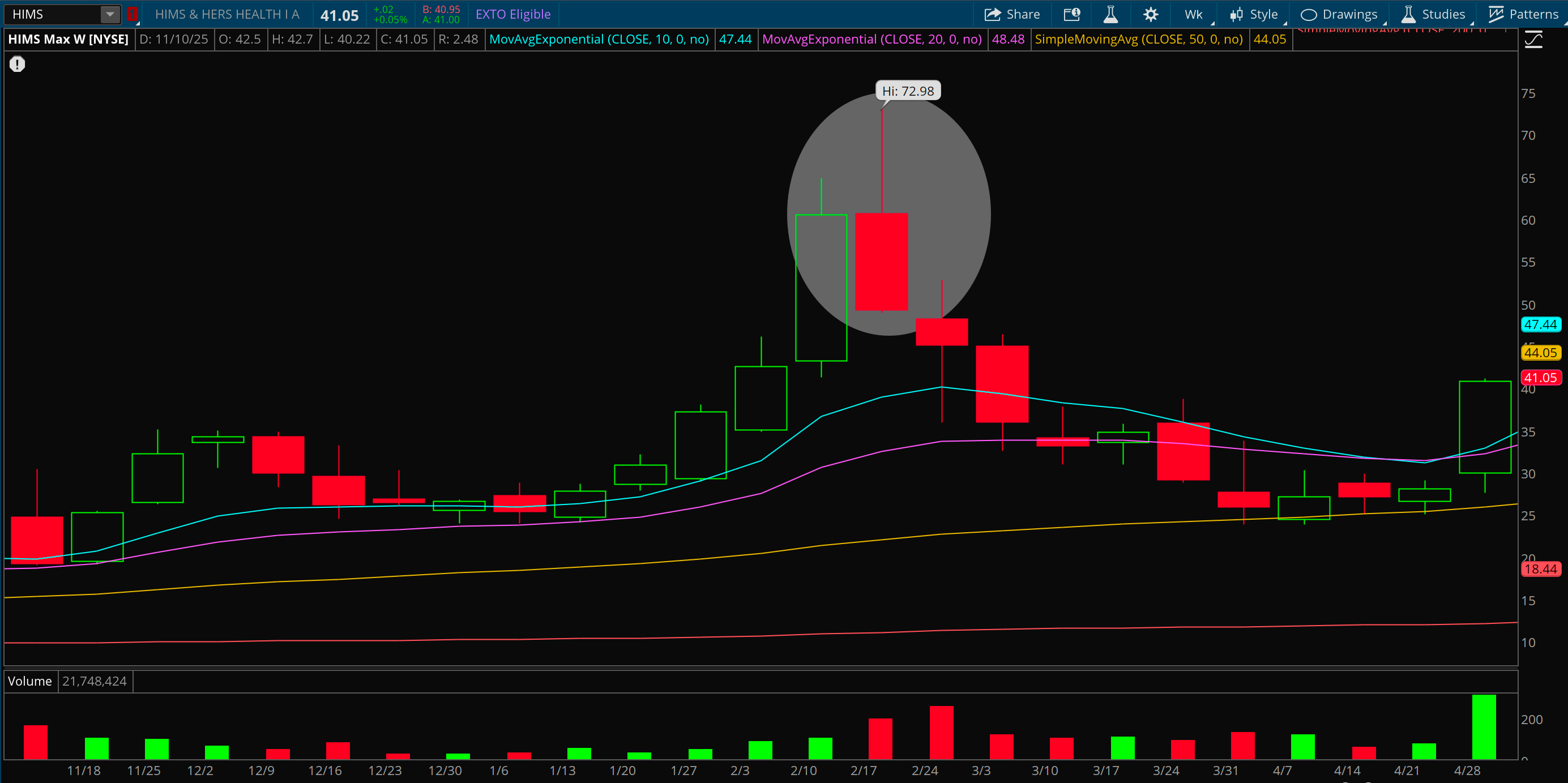
See how long the upper wick is? You can also see it in the Tesla example above, very similar. These are some of the ugliest candles you can get, especially when a stock is extended from weekly moving averages. It often always signals a reversal to the mean (moving averages). Stocks don’t go up forever without testing weekly moving averages!
4. Multiple High Volume Red Weeks
When I start seeing multiple high volume red weeks in a row, that to me reads like potential institutional selling. Retail can’t move stocks, it’s more our job to just get along for the ride. Big volume either green or red is almost never retail, we don’t have billions of dollars to move stocks. Institutions and funds do though.
Heavy red weeks signal unloading before a potential pullback The stock might not crash right away but it starts to lose its rhythm because instituonal buyers are far less likely to be emotional and flip in and out of positions. Once they’re positioned, they sit and wait. That’s what the best traders and funds do, they’re not day trading. After big money exits, rallies fade faster, strength gets sold into, and bounces carries less energy.
5. Fast 10%+ Move After Entry
When a position jumps 10% or more right after I buy, I almost always trim some. Usually around 20%. Once I trim some, I can sit in the position and know for a fsact that the position and trade will end with a profit. This allows me to sit through volatility and feel comfortable because I know none of my principal is at risk. Once a trade goes up 10%, you should never let it turn red on you. Ever. It’s much easier to think and manage a trade when we’re playing with “house money.” If the stock keeps running, awesome because I still have 80% of my position. If it sells back to my entry, I can exit and still get out with a profit because of that initial trim.
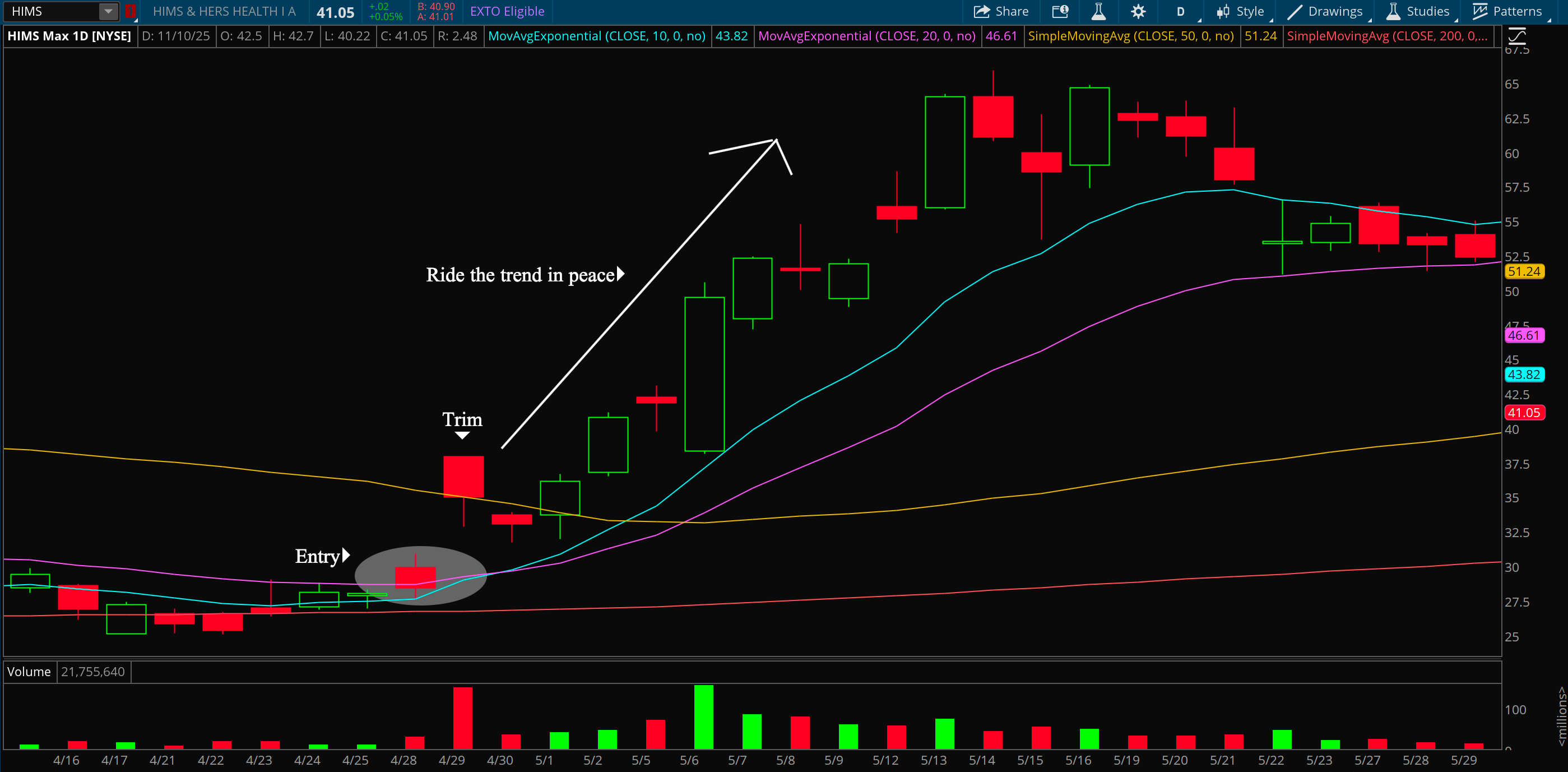
This was one of my best trades of the entire year. I got very lucky with this entry, I can’t deny that. I had been watching Hims base for weeks and once it closed over both the 10 and 20 day moving average, I took an entry. The next day it ripped 35% after a deal with Novo Nordisk. I was also watching the weekly chart and it happened to be basing right against the 50 week, that was the big signal I used to buy.
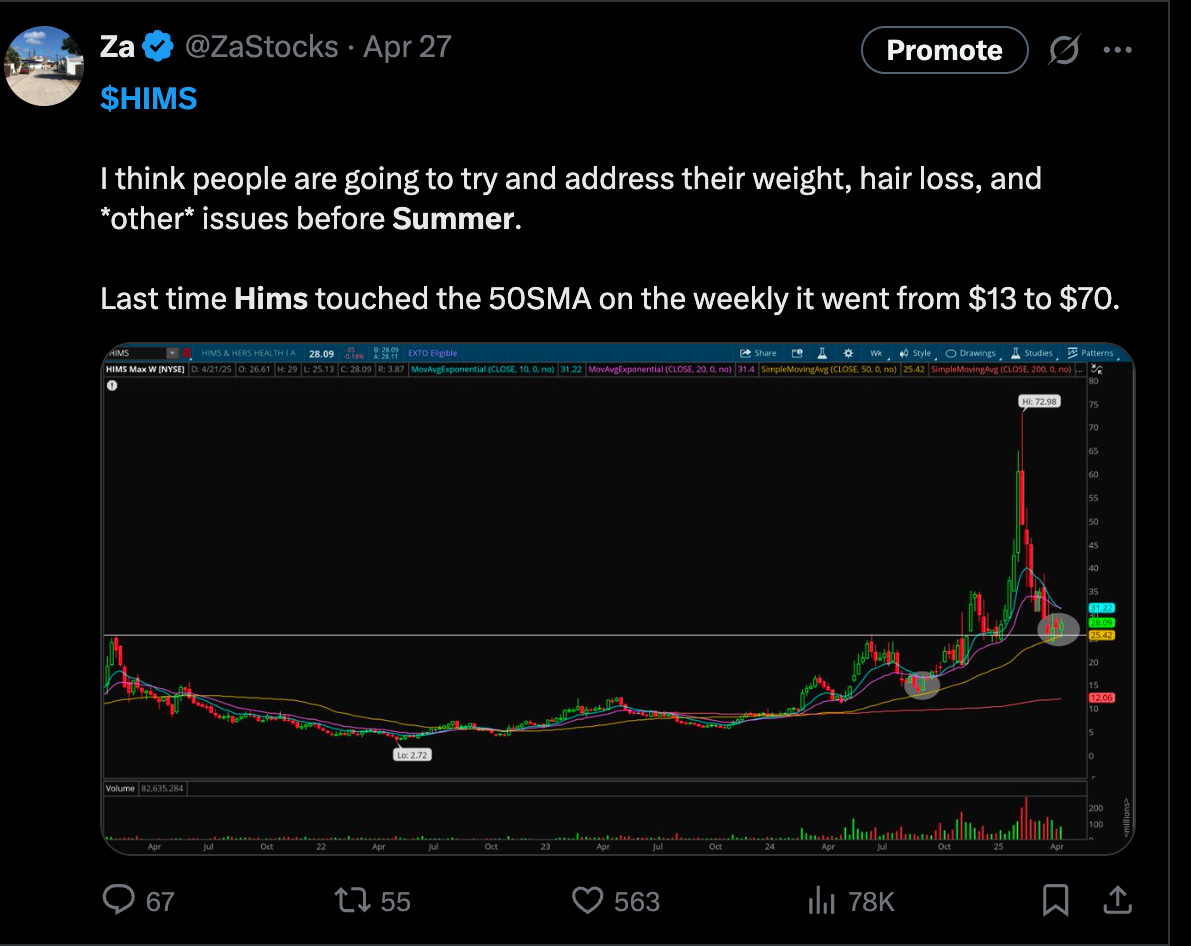
You can see on the weekly, last time it touched the 50 week moving average it ripped hundreds of percent. I made almost 100% in just a few weeks! This was shortly after the tariff crash so we had the momentum of the market at our back as well.
6. Lower Highs, Lower Lows
The transition from an uptrend to a downtrend doesn’t happen overnight… it starts with very subtle hints on the chart, one of those big hints is lower highs and lower lows. Ideally I like to be out once the first lower low and lower high is made, I don’t want to stick around for the trend to continue. If I’m wrong and it makes a new high, I can accept that and move on to the next trade!
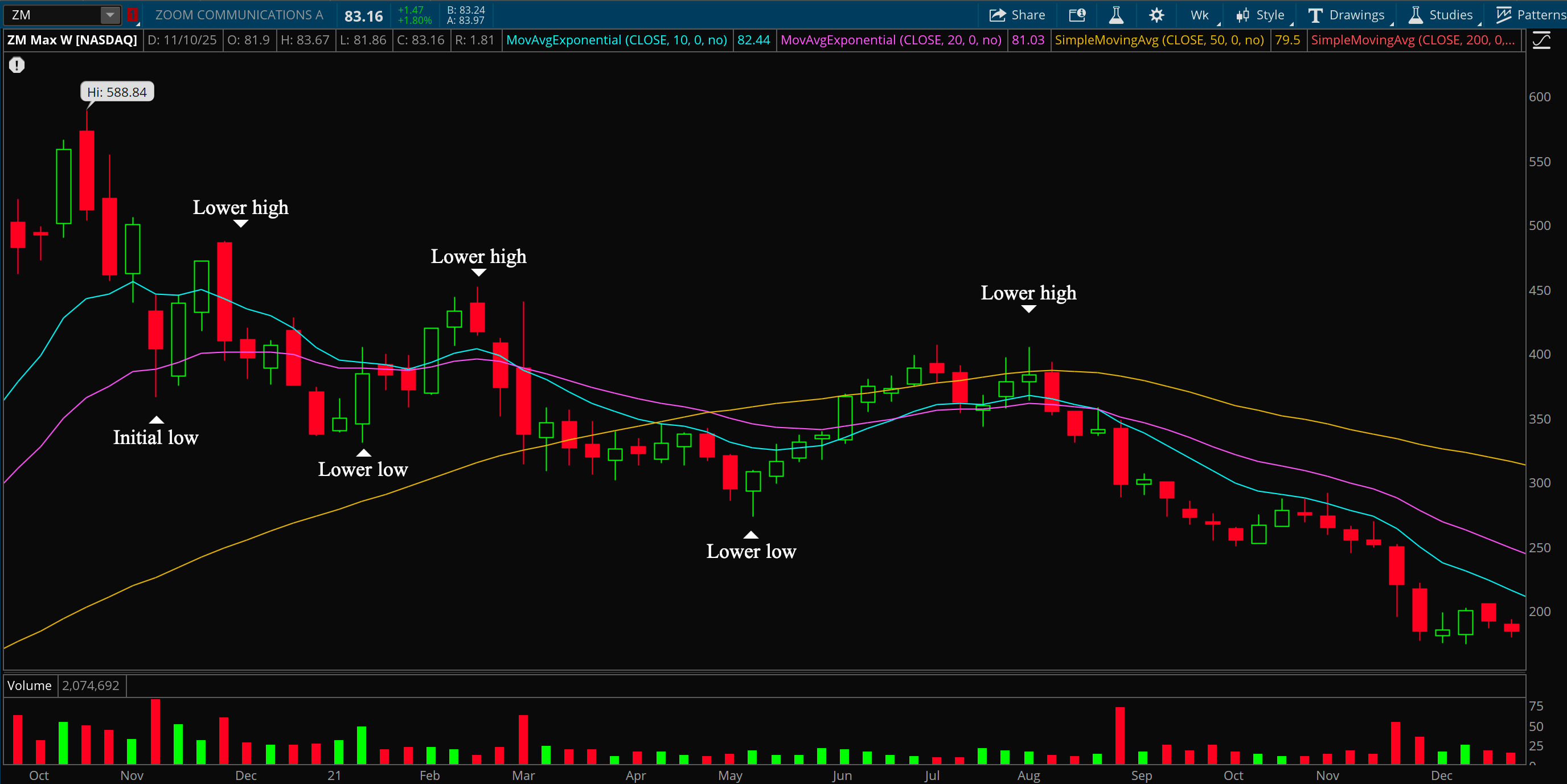
You can see this chart on Zoom, it’s textbook. The second lower high was the time to get out, it was very clear what was happening here. Especially because the moving averages all got clustered and messy but that’s a post for another day. If I was in Zoom, I would have been out the week after the lower high. That week it also happened to close below the 10/20 week moving averages.
7. Relative weakness
When the overall market or sector of the stock you’re in is ripping and your stock isn’t, that’s a major red flag. We want to be in strong stocks, not weak ones… if I’m in a stock that is starting to weaken while the rest of the sector is strong, I’ll often cut it and try to get positioned in a leader.
Relative weakness often shows up before the chart fully breaks. It’s one of the most underrated sell signals out there. When the stock you’re in can’t rally even when the market and sector is healthy, that is a big signal.
Trading and investing sell criteria differ, but the core principle remains. When your thesis changes, get out.
This is my guide to selling both long term investments and trades. As I said in the beginning, there is no one size fits all rule for selling, but we can use frameworks and patterns to help us make better decisions. Selling is never easy whether it’s a position you’ve held for years or a trade you’ve been in for a few days/weeks/months.
Remember, the goal isn’t to sell perfectly or to time the top. That’s almost impossible and a suckers game. The goal is to sell well… every sell decision is ultimately about protecting capital. Protecting capital is what allows us to stay in the game long enough to compound!
I hope you all enjoyed. In the comments, let me know what ideas you have for these educational pieces. I’m happy to take any and all ideas you might have!
Have a great night.
By reading or acting on any content in this newsletter, you acknowledge and agree to the following terms of service.
I didn’t expect anything less from u za. Always quality
10/10 post. Thank you!